
internet

More online newspaperism

The Guardian examines the dilemma of the headline writer as newspapers "integrate their web and press productions:"

Headline writing, of the clever, punning variety that is their stock in trade, is fast becoming an anachronism. For the role of subeditors is changing as media organisations do as the Sun has done and establish integrated newsrooms; producing papers, website, blogs and broadcasts from one desk.
But there's an underlying false assumption: that newspapers can/should consider the Web to be an "edition" of a "newspaper."

I think newspapers should examine, exploit and even celebrate the unique characteristics of each medium, resulting in products that are complementary rather than competitive with one another.

Certainly print headlines and online headlines have to meet entirely different requirements. We've known that for years. Print is a serendipity medium where puns, clever language and cultural references can work really well. Online is an information-seeker's medium (and that was true long before Google) where a clear and straightforward phrase wins the game.

Print is not dead, and backing down on brilliant print headline-writing would be a terrible mistake.

Thanks to The Editors Weblog for the pointer.

The rising value of the online user

According to E&P, Bank of America analyst Joe Arns says the value of an online reader to a newspaper company is on the rise:

Based on the total ad revenue per reader, in Q2 Bank of America estimates that on average, newspaper publishers generated about $25 to $38 of ad revenue per daily online reader compared with $70 for each print daily reader. This suggests that online readers are worth about 36% to 55% of the value of print readers, up from 28% to 42% in Q2 2006.

I'd like to see the full "show your work" calculations. I continue to believe that the readership claims of newspaper websites are inflated by irrelevant, drive-by traffic that bloats the unique-user count and depresses derivatives such as revenue per user.

It's been a couple of years since I did any heavy-duty behavioral analysis on a newspaper website, but I don't think the numbers have changed all that much. What I found then was an easily identifiable, but small, group of habituated users and very large population of one-hit drive-by visitors.

If you ignore the drive-by traffic and divide revenue by habituated users, you get a pretty powerful story about the potential of local Internet advertising revenue ... and you can see that our challenge is to build that habituated readership.

As I've said before:

... the problems are much more driven by a weakening ability to deliver an audience in any medium than by any inherent weakness of an online advertising model. At the end of the day it comes down to a simple question: Are your content and services relevant to consumers in your market?

Don't blame the Internet, or the owners

On the day of 60 "early retirements" from the St. Louis Post-Dispatch, columnist Bill McClellan feels like a dinosaur witnessing the end of his era, and he points to two meteoric events. One is the arrival of the Internet. The other is corporate ownership.

That's probably a popular viewpoint in most newsrooms these days. And there is some truth to it. But in the big picture it's wrong.

Newspapers, particularly the flagship major metros, aren't in trouble because of the Internet and corporate ownership. They're in trouble for a whole lot of reasons that all too often get overlooked. They include:

  • Journalistic arrogance, the dark side of the professionalization that took place in the 20th century. The arrogant authoritarianism of newspaper journalism set us up for a fall. A lot of people just plain don't like us.
  • Big changes in consumer retailing. Local department stores like St. Louis' Famous, Barr & Co. and Stix, Baer & Fuller are no longer around to buy those big full-age ads on A3 featuring women in their underwear. We shop now at suburban malls, Wal-Mart and Best Buy. National chain-store branding and physical location have displaced local merchandise advertising as a primary marketing tool. Much of the retail advertising that newspapers still get has moved from high-dollar ROP to low-dollar inserts.
  • Explosive growth in broadcast and cable TV. Sometime in the 1990s, newspapers lost their grip on the morning, replaced by television, just as newspapers lost their grip on the evenings in the 1970s. As the eyeballs have migrated from print to TV to cable, so has a lot of small-business advertising. Pretty much every cable carrier has a sales force (or is contracted with one) that's out calling on sole-proprietor businesses in strip malls and shopping centers. A lot of those folks never see a newspaper ad salesperson.
  • A long, slow slide toward irrelevancy through the loss of readership driven by generational change. Using General Social Survey data, Philip Meyer has documented the decline of newspaper readership since 1970, and it's easy to see that something other than the Internet is at work. Even if the Internet had never happened, newspapers -- especially big-city papers -- have long been headed for a dangerous inflection point at which their market penetration would not be sufficient to sustain a mass-media business model.
  • The iPod, the Xbox, the DVD player and every other electronic toy and gizmo that sucks up time and attention, ultimately competing with the act of reading and the very concept of being involved in
    local civic life.
  • Market fluctuations. I'm the first person to point at longterm trends and ignore the short-term cycles, but in this case we're experiencing both climate change and very nasty weather. There is a deep malaise in the American economy right now, and it's much worse than any of the spinners in Washington will admit. Maybe if we hadn't wasted $455 billion in a fit of neocon world-domination arrogance, we wouldn't be facing a wrecked economy.
  • The Internet, and the corporate ownership model. I don't want to let them off the hook entirely. I just want to point out that it's not one or two meteoric events that have put us where we are today.

(Note: I worked in St. Louis in the 1970s and 1980s at the Globe-Democrat, which went out of business in 1986.)

The world in the palm of your hand

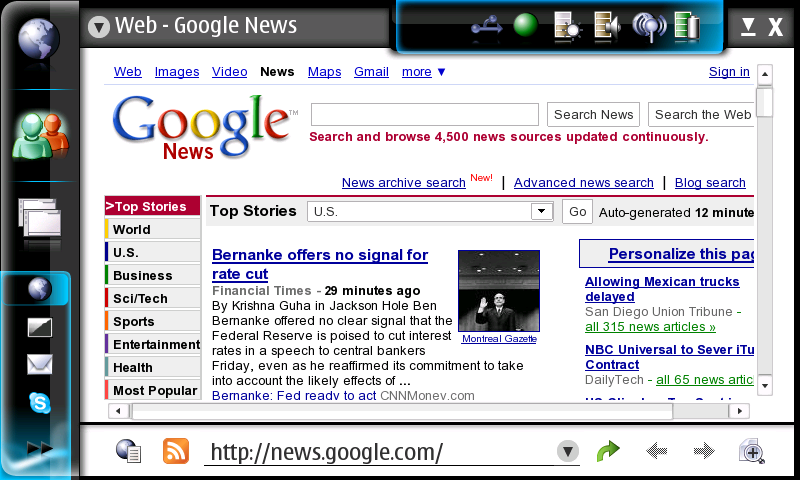
For the last couple of days I've been playing with my latest tech toy, the Nokia "please don't call it a phone" N800.

This and similar devices, including the iPhone, have world-changing implications for newsgathering as well as publishing and distribution.

I'll get to those points shortly, but first a few words about why I went with the N800.

I conquered my iPhone lust rather quickly by thinking about the true cost, which (including the mandatory contract) some have estimated at well over $2,000 with opportunity costs as high as $17,670. Coincidentally, that high figure is about a dollar per word in the restrictive contract.

So, for $357.98 on Amazon.com I bought the N800, which is not a phone. It's an Internet tablet. Like the iPhone, it uses Wi-fi connections if they're available. Unlike the iPhone, it doesn't use the phone network ... unless you have a Bluetooth-capable cellphone in your pocket. That's my next step, which I'll take when I get around to it. My current phone, which runs Microsoft's hellish mobile phone software, doesn't do Bluetooth.

The N800 does let me make worldwide phone calls via Skype, which isn't available for the iPhone. And it includes a Web browser with both Opera and Mozilla engines, full Ajax, and Flash 9. It has instant messaging on pretty much every existing service, email, games and several media players. I can listen to the BBC streaming through the net, or local radio stations via FM. I can watch YouTube.

It lacks Apple's single-minded focus on simplicity. What you get in trade is flexibility and openness -- under the hood, it's running Debian Linux. And unlike the iPhone, Nokia lets you open the hood and tinker as much as you want.

For the mobile journalist, this could be the office in a pocket. Forget the backpack. Paired with an $80 folding Bluetooth keyboard, you have a pretty decent ultralight writing workstation. Add a camera that stores images or videos on an SD card and you can file (or blog) from Taco Bell. (The SD card is necessary because the N800 doesn't have a host-mode USB connector, but it does have a card reader.)

For everyone else, this is the world in your pocket. It's the real Internet, not the fake Internet the telcos have been peddling. The zoomable, 800-pixel browser means you can know everything that can be discovered through Google and Wikipedia. Every news site, every blog, every MP3 stream, every podcast.

But isn't the Wi-fi limitation a problem? Less than you might think. Where I work in Augusta, Ga., there is free Wi-fi all over downtown: city-supplied service on the Augusta Common, open service at most of the bars and restaurants. Fast-food joints, libraries and most hotels provide free service. I can read BBC News while waiting in the car line at Wendy's. Sprint is supposedly preparing a version of the N800 that will use Wi-max, a wide-area broadband technology that can blanket entire cities just like cellphones can.

So, why would you pick up a copy of the local newspaper to read over lunch if you have all of this at your fingertips?

Websites no longer have to offer horrid phone-tech services in order to reach mobile users. Pretty much everything currently deployed will work just fine.

But there is a challenge easily overlooked: Create new kinds of content and services tailored to mobile needs. That's where the opportunities are waiting, and if our track record holds up, it's where local newspapers will drop the ball. We now have the whole world at our fingertips, but it doesn't have to be the old world.

Only one click away

While reading coverage of the Minneapolis bridge collapse this morning, I was reminded how, on the Internet, all the world's media resources are just one click away, which is a boon for consumers but creates a difficult environment for producers, who now have to compete with everything at once.

Quite a few comments on the New York Times website were from Minnesotans. "It has been surreal to view images of a place one block away from where I live," wrote one. "My house is about seven blocks from the bridge that collapsed," reported another. "The bridge literally collapsed about two blocks from my apartment. I had gone over the bridge just an hour before it collapsed," wrote a third. Several people posted links to resources on startribune.com.

I drove across that bridge just about every work day for nearly 14 years. There were questions raised about its structural integrity in the early 1990s. I can remember an inspection-and-repair unit that hung off the side of the bridge for months. The bridge is just downstream from a dam that kicks up mist (creating a chronic ice problem in the winter), and like all reinforced concrete structures in Minnesota, it's had problems with road salt that seeps into the concrete and attacks the rebar.

How the iPhone threatens newspapers

Journalists are chronically confused about why people read newspapers. As Clayton Christensen has pointed out, the best way to understand product-market relationships is this: People don't buy products; they hire products to get specific jobs done.

One of the reasons people read newspapers involves the recycling of downtime. If you read a newspaper while eating lunch, you can entertain yourself while feeding yourself. Or perhaps you're using it to avoid people you really don't want to talk with. Or escape the uncomfortable feeling that you're dining alone in a crowded restaurant. Or whatever.

In any case, there's probably a very personal reason involved that is something quite different from "getting the news" and stepping up to your responsibility to be a well-informed citizen. Those are benefits, especially benefits to society, but they may be quite disconnected from the actual decision to pick up the newspaper and read it.

Which brings me to the iPhone. In a contest to serve any of these purposes, which one is going to win?

  1. A newspaper, whether it be the daily Bugle or the weekly Whining Alternative.
  2. Everything on the entire Internet, interactive and in color.

Easy: #2 is going to paste #1.

The point here is not to predict the ultimate victory of the iPhone over all forms of media. The iPhone is at this point a perfect product because it hasn't been sold and nobody has had a chance to discover the limitations and annoyances that inevitably come with real-world products.

The point is simply to illustrate why discussions of old-media business models such as charging for content are pointless. We are awash in a sea of new choices competing for our time and our attention. Some of these new choices are inherently superior solutions for some of the jobs for which print media used to be hired.

Let's bury the digital divide myth

In most newsrooms, if you chat long enough, someone will bring up the moldy old question: What about the digital divide?

Let's bury that.

Some 60 million U.S. households have Internet access. Daily newspapers reach only about 50 million households. Should we be talking about the print partition? The crushed-tree chasm?

Jakob Nielsen tackles the subject in his column this week, noting that falling prices for computer technology have demolished the "economic divide" argument.

Nielsen also notes that senior citizens constitute the "main remaining source of growth in Internet use."

At work I keep a pretty close eye on the characteristics of active users on our local websites -- community bloggers, photographers -- and it's impressive how older users have joined in the conversation. The notion that the Internet is for young people and print is for old people is another one that should go away.

Time has a way of tossing us all into the latter category, willing or not. It's better than the alternative. We can take our laptops with us.

Syndicate content