
change

Rolling over in Walter Williams' grave

I had dinner Friday night with Dean Mills and several other folks from the University of Missouri J-School. Not one word was said about the death of print, the crushing debt loads taken on by big publishing companies, or other depressing topics that tend to dominate journalism conversations (and blogs) these days.

It was an upbeat conversation about exciting possibilities, all hope and energy and yes, optimism. Mizzou has all sorts of fascinating projects in the works.

In the background, though, I was thinking about the  Columbia Missourian, for 99 years the keystone of the hands-on Missouri Method of teaching journalism.

The Missourian isn't a school newspaper -- it's a serious, professional, commercial daily newspaper that's operated as a teaching laboratory.

As the Number Two newspaper in a small town, it's having big financial difficulties. To be honest, hardly anybody on the "town" side of the "town vs. gown" divide reads it, and I don't think it's doing all that well on the "gown" side, either. You can't sell advertising in a paper that doesn't reach an audience that advertisers need.

Losses at the Missourian are running well over a million dollars a year, leading to talk of cutting the Missourian back from its daily publication cycle and focusing more on the Web.

Last year it spent $1.67 million on print-related expenses (composition, printing, mailroom, circulation) and only $93,722 on Web expenses, so it's not exactly been starving the past to feed the future. The daily paper reaches 7,400; a weekend free sheet reaches 43,000 homes, and the Web product claims 100,000 unique users. Think about that.

Maybe the Missourian becomes a Web-focused operation with a weekly print product, or more likely, an array of multiple targeted products. It already has a weekly free entertainment tab and a Hispanic-targeted product.

Or perhaps it might  buddy up with the competition: Hank Waters' Columbia Tribune, the "town" paper.

I've known for awhile that these ideas were simmering in Mizzou's pot. The path forward might seem pretty straightforward and obvious. But it's not simple, because of a risk of a potential backlash from donors.

Make no mistake about it: Higher education lives or dies on the largesse of donors, mostly alumni. The ones with the most to give tend to be older, which right now puts them on the opposite side of the digital revolution. Many fondly remember their college years on the staff of the Missourian, which until recently even operated its own presses.

These ideas about radically changing the Missourian are now in the open, and some people don't like it one bit. Dalton Wright, publisher of a small daily in Lebanon, Mo., and a member of the Missourian's board, already has been quoted: "I think Walter Williams would be turning over in his grave."

But I wonder how Williams really would react. What would make him roll over in his grave?

Walter Williams, for those who don't know the story, was the guy who founded both the Missouri School of Journalism and the Missourian, so you might think he'd have a sentimental attachment to the past.

But Williams was a change agent. He was a guy with a high school education who talked the Missouri General Assembly into creating the world's first journalism school at a time when reporters served trade apprenticeships rather than getting formal educations. Williams was a guy who never attended college, yet got himself appointed dean of that radical new school, then rose to become president of the University of Missouri.

It's easy when you walk through an ivy-covered campus, looking at statues and portraits of great men and women who were founders and builders and creators of empires, to drift into nostalgic fantasies about tradition and past glories. We all do it.

But those people in the portraits were pioneers, risk-takers, change agents. We don't honor their memory by clinging to what they built, but rather by understanding why they did what they did and finding new ways to apply those principles in modern contexts. Embracing the future requires learning from the past, but also letting go of it.

We need our universities to not merely churn out qualified job applicants. We need universities to take a constructive role in research, analysis, ideation and experimentation. We need help to figure out the new forms of journalism -- and the business models to support it -- that will serve society in the digital future. I hope potential donors will see and honor the needs of the future and not get stuck on preservation of the past.

At lunch Saturday, Gary Kebbel told me about a new Knight Foundation project:  a five-year, $24 million challenge grant program targeted at local information needs.

It's not handing money to projects to save newspapers. It's looking to persuade local community foundations to adopt the cause of "creative uses of media and technology to help keep communities informed and their citizens engaged."

It's open-ended and forward-looking, and likely to lead to some projects that many might not recognize as "journalism." But isn't keeping "communities informed and citizens engaged" what drew people like Walter Williams into newspapering in the first place?

It's just unevenly distributed

David Kurtz, who writes for Josh Marshall's great political blog Talking Points Memo, is at the International Press Institute congress in Belgrade and observes that the angst being felt by American newspapers isn't being felt everywhere:
"In a provocatively titled panel -- 'Are Profits Killing the News?' -- William Green, the editor of Time Europe, was nearly at his wit's end, although diplomatically so, in trying to get two major European publishers to acknowledge and address the cutbacks in news and the effect of the industry's financial struggles on journalism itself."

But it's true. The future is unevenly distributed. In recent years I've attended publishing conferences and workshops and seminars in Istanbul (last year's IPI congress), Moscow, Macau, Kuala Lumpur, Strassbourg, Paris and Stockholm. There is no universal publishing disaster. The publishing industry isn't dying; it's changing at variables rates and in some places (like India, where I'm headed in September) printed newspapers are actually booming. In some markets, like Norway, newspapers have become the dominant online service provider. In cities all over the world that have subways and rail transit, free commuter papers are popping up like mushrooms after a spring rain (and occasionally disappearing as quickly). The world is a very diverse place.

At the moment, the United States just happens to be an ugly example of what happens when you combine disruptive technology, a business model heavily dependent on classified advertising, a disastrously mismanaged economy and a business infrastructure financed by the public markets. It's a perfect storm, which doesn't seem to be so perfect if you're one of the 1,400 people targeted for layoffs at McClatchy.

Feeling old

I just posted something on Alan Mutter's blog -- an item about planned redesigns at Tribune Company newspapers -- and realized afterward that hardly anybody currently employed at an American newspaper will have any idea why I referred to "funereal column rules" in Peter Palozzo's design for the old Chicago Daily News.

Friday I was chatting with a woman at work, much younger than myself, who has an unusual necklace, a gift from her newspaperman father. It's a Linotype matrix, a little brass mold for setting the letter F in type ("type" meaning molten lead, not pixels on a screen). She wore it on a visit to one of our newspapers. The executive editor asked her if it was some sort of Star Trek thing.

Here's the Palozzo explanation.

In the final days of the struggling Chicago Daily News, art director Peter Palozzo was brought in to try some visual shock therapy. He produced a design that had a jiggy new Bookman Swash logo and broke the pages into three vertical sections, each separated by a thick black line. You could fold the paper and read it on the El.

It was funereal, because in the days of hot type it was common for major stories of great sadness for a paper to "turn the rules" -- literally flip the lead column dividers upside down, so the fat base instead of the thin top presented itself. In other words, a thick black line.

Before this post there was not one single reference on the Internet to "turn the rules" and "hot type." Things change. We move on.

Life after the coming tsunami

The other day in an email to a friend I referred to "the economic tsunami that seems headed for the U.S. newspaper industry."

Is that overstated? If you recently lost your job in a newsroom cutback, you probably don't think so.

But when I was traveling last week I saw something that surprised me.

The "Boxing Day tsunami" from the 2004 Great Sumatra-Andaman earthquake was a horrible thing, leading to 300,000 deaths and staggering destruction.

Many of us watched the amateur videos that were quickly posted to the Internet, some of them shot on camera phones.

We saw buildings collapsing, people pulled into the sea, and far worse.

Yet in my stay on Ko Phuket, on the Andaman sea in Thailand, I didn't see defeat. I saw life going on, undoubtedly changed but nevertheless defined by optimism and growth. I saw new construction. I saw hotels full of happy tourists and restaurants full of diners.

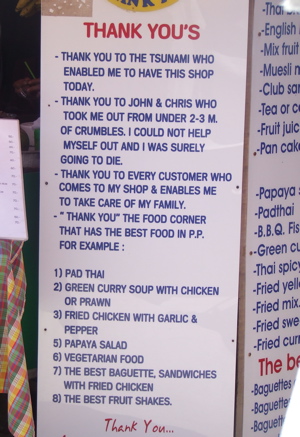
And on a food stand sign on Ko Phi Phi I ran across a sign: "Thank you to the tsunami that enabled me to have this shop today."

It was a powerful reminder that in any great change, even one as horrible as the 2004 tsunami, there are going to be winners.

Which we be? That is likely to turn on how we respond. We can sit and bemoan the passing of the era of the great metropolitan newspaper or we can choose to look for ways to invent the future. I think journalism will be changed, but it's going to survive.

My generation

Core newspaper readers?

When do we become the roadblock?

One day I was doing some consulting and sat down with a new media director to talk about how he might work to make his website more complimentary and less directly competitive with his newspaper.

Develop the interactive community, I said.

But that takes time and people that I don't have, he said.

Stop putting all your time into cutting and pasting newspaper stories onto the web, I said. Your limits are real, but you can reallocate. Make your website an interactive center of the community. Lead discussions instead of trying to duplicate the newspaper. Let print be best at what it does, and use the Internet for its interactive strengths.

But my news guy won't like it, he said. The news guy signed up to put news stories online, not run bulletin boards. He'll quit.

I've thought about that interaction often recently.

Across the country, there are moves to integrate online and print departments. Reporters and photographers are being asked -- finally! -- to recognize that they have multimedia responsibilities. Newsrooms are being renamed "information centers" and asked to accept responsibilities for non-news information, utility data, "evergreen" resources. And online "divisions" are disappearing.

Not surprisingly, some people don't like this. But the pushback isn't always from some mossback from the print side who's still acting like it's 1987. Sometimes it's from the online side.

Middle managers everywhere naturally resist anything that might diminish their power bases. It shouldn't be surprising that onliners, too, can become agents of stasis rather than agents of change. We need to be on guard against that.

Not all change is good, and it's appropriate to speak out, to raise issues that need attention. But we need to make sure that we're raising issues that are real and not merely looking for ways to protect our positions of power or independence. Let's not become the new roadblock.

Catching up

I was on the road all last week, and I didn't live-blog a remarkable seminar in Los Angeles for two reasons. One: the usual annoyingly bad hotel wifi connection in the conference rooms. Two: I didn't want to invade the privacy of the participants. In the prep work, one of the editors quipped that he was reluctant to document his vision because these days his memo would immediately wind up on Romenesko. Sometimes we need to talk privately in order to work publicly.

Ten top print editors of large newspapers were paired with their top online editors. In this era of online/offline integration, the print guys have some serious catching up to do and the online guys have a tough enough time keeping up. It's to their credit that they took four long, intense days away from the office to focus on learning about digital media. Learning requires that you drop your natural defenses and admit your shortcomings, something that's not easy to do, especially when you're supposed to be the alpha dog.

They emerged with plans to launch some new projects and change some existing plans. One major newspaper will be adding aggregation -- identifying, pointing, linking to other peoples' content -- to their political campaign coverage. That's a significant step for an institution founded on closed-circle journalism. More importantly, they emerged with thoughtful positions on why we need to move to open and conversationally engaged journalism models.

I heard a lot of excitement about widgets -- the tools (often driven by Javascript or XML interfaces) that make it possible to embed live information from external sources in Web pages. Most of that excitement was about the possibility of distribution, rather than incorporation, but I heard openness to both. This concept of live interoperation with other peoples' websites is tough to get across to many software engineers, and I was encouraged by the editors' reactions.

The best news may be what I didn't hear: defensiveness. I didn't hear a bunch of talk about protecting the old core. Or any nonsense about cannibalization.

It's easy to snipe at newspapers for "too little, too late," but I think we're actually in a cycle of irrational negativity about their prospects. There is much unharvested opportunity in local markets, and if newspapers can focus their very substantial resources in the right directions, there's a future to be found.

It's possible, of course, for all the good intentions to be forgotten when everyone gets pulled back into the crush of daily work, but the foundations have been laid.

Thanks to the Knight New Media Center for pulling this together.

Syndicate content