
blogging

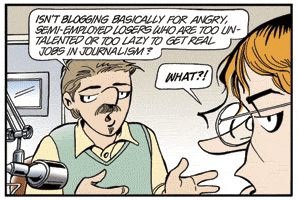
Can we finally bury the "bloggers only comment, don't report" canard?

Now that Josh Marshall's Talking Points Memo political blog has won a George Polk Award for legal reporting, can we please officially bury the tired old nonsense about blogging not being real journalism? Editor and Publisher quotes the announcement: "His site, www.talkingpointsmemo.com, led the news media coverage of the politically motivated dismissals of United States attorneys across the country. Noting a similarity between firings in Arkansas and California, Marshall (with staff reporter-bloggers Paul Kiel and Justin Rood) connected the dots and found a pattern of federal prosecutors being forced from office for failing to do the Bush Administration's bidding."
Politics and citizen media

All journalism has political implications, and we're seeing that play out in the citizen media space.

Kevin Anderson describes how Google/YouTube has muzzled Egyptian blogger Wael Abbas, who has been posting videos of torture and official violence in Egypt.

Asia Times Online describes the role played by bloggers in Malaysia where it says "independent news websites and blogs have enjoyed a surge in popularity on the back of two huge demonstrations and retaliatory government crackdowns in the heart of Kuala Lumpur, which the mainstream media arguably failed to report accurately or adequately.

(Kevin and I taught last summer at an Ifra citizen media workshop in Kuala Lumpur that was attended by mainstream journalists from Malaysia, Singapore, Thailand and India.)

The diverse, open platform provided by the Internet has perforated the ability of autocrats and bureaucrats to control information. But messages need audiences. Centralized systems like YouTube can provide those audiences, but at a cost of creating a centralized point of control that may be manipulated by governmental pressure.

Both Google and Yahoo have shown repeatedly that when the chips are down, their commercial interests will trump social responsibilities.

Hype it with the facts

Mark Potts criticizes breathless misreporting by journalist-bloggers:

We hold bloggers to somewhat different standards than journalists, because the vast majority of them aren't, well, journalists. But is it too much to ask that journalist-bloggers retain a modicum of professional ethics about what they post and how they post it? Everybody who's been involved in stories that get caught up in the media blogosphere vortex seems to have a horror tale about a journalist-blogger posting something without checking facts or asking for comment—or jumping to conclusions based on personal biases. It happens way too often, and it's just sloppy. And when it comes from a journalist-blogger writing under the imprimatur of a journalism site, it's inexcusable.

There's a great line from All the President's Men that applies perfectly here, as it does to all journalism: "If you're going to hype it, hype it with the facts."

Mudslide in Ohio

Tuesday I'm in Pickerington, Ohio, a suburb of Columbus, to lead a daylong "citizen journalism" training workshop. Undoubtedly the meltdown at the Plain Dealer will be one of the topics of conversation. Noteworthy links:

Wide Open blog bumps up against journalistic ethics: Cleveland Reader Rep Ted Diadiun explains how "The Plain Dealer got itself spattered by some primordial ooze last week" and concludes with "You can't contribute to a political candidate and then write about his or her campaign, either as an employee or as a paid free-lancer for The Plain Dealer, on paper or online. Period."

Jeff Jarvis responds: "The problem, in my view, is that Diadiun isn’t listening and learning. That, you’d think, would be the fundamental qualification for his job. ... Diadiun just defends the paper against an accusation of buckling to political pressure and lashes out at the bloggers as aliens to the newspaper ways."

Jay Rosen says:"If you’re caught up in a situation that appears to pit journalists with ethics against bloggers who ain’t got none, you may actually be facing a conflict between one ethic and another, and it would be good to find out what the “other” is before deciding what to do."

My favorite, though, is a buried comment on Jarvis' site from Jill Miller Zimon observing that she's written Plain Dealer op-ed pieces many times, and never has been asked whether she has donated to anyone's political campaigns, or advised of any policy against it.

Related items: MSNBC's list of journalists who have contributed to candidates and a rundown of varying policies regarding political activity.

Straw man bites Andrew Keen

In my book Andrew Keen is a pompous fraud and I wouldn't cross the street to put him out if he were on fire, so I particularly enjoyed seeing Markos Moulitsas expose Keen's sloppy "professionalism."

Moulitsas (aka Kos) quotes Keen's book...

It is not surprising then that these prominent bloggers have no professional training in the collection of news. After all, who needs a degree in journalism to post a hyperlink on a Web site? Markos Moulitsas Zuniga, for example, the founder of Daily Kos, a left-leaning site, came to political blogging via the technology industry and the military.

... and then points out that he (Kos) has a degree in journalism (as well as several others), served as editor of his college newspaper, freelanced several years for the Chicago Tribune and has written for the Guardian. (Thanks to Martin Stabe.)

Keen is not a journalist but rather a professional self-promoter. Nevertheless, his straw-man dismissal of blogging is a position still held by too many in journalism.

Across the pond in the UK, there's a bit of a revolt against the National Union of Journalists over luddite positions being taken by the union. Suw and Kevin take a swing, and Neil McIntosh offers some suggestions as to how the NUJ could make itself useful.

The sports power struggle

Writing for followthemedia.com, Philip Stone has a good roundup of the blooming power struggle between sports sanctioning organizations and the media.

At the other end of the spectrum, Steve Klein notes that the National Hockey League is setting up a "blog box" -- a special area for live bloggers -- at some of its venues.

What's going on? Is the NHL enlightened and the rest of the sports world stuck in the dark ages?

I don't think so. This is fairly simple: It's all about power. The strike-weakened NHL needs all the attention it can get. Other sanctioning bodies are feeling secure, and they're going to grab for what they can.

CNN does the right thing

The blogs are abuzz this morning with the news that CNN has decided to allow unrestricted reuse of the televised New Hampshire presidential primary debates. It's the right thing to do for all sorts of reasons. Much of the commentary repeats the claim that CNN is releasing the video under a Creative Commons license, but the announcement makes no such claim, rather using the language "without restrictions."

Both John Edwards and Barack Obama previously had asked that future debates be licensed under a Creative Commons license, apparently reacting to (MS)NBC's hoarding of video from the South Carolina debate of Democratic contenders.

The problem with Creative Commons is that it isn't a license, but rather a confusing family of related licenses, some of which have ill-defined restrictions -- notably "noncommercial." In this world in which everyone can be a publisher, and everyone can paste ad-network code into a website template, what is commercial and what is not? "No restrictions" is much a better policy for the debate video.

Syndicate content