
Here's an image I've been using a lot lately, both for internal training and external presentations such as last week's BPB Forum Lokaljournalismus in Schwerin, Germany.
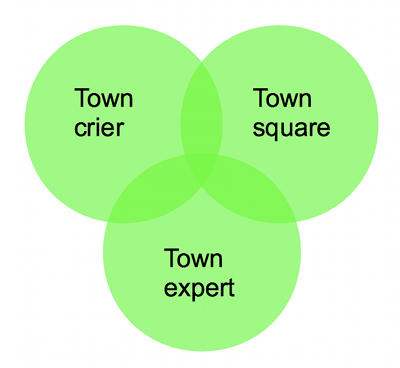
Journalists tend to gravitate to only one of these roles: the town crier, the quaint colonial-era village character who walks around ringing a bell telling you what's happening. It comes naturally.

This is why 24x7 coverage teams and the "continuous news desk" concept take root so quickly when newsrooms suddenly awaken to the urgency of taking the Internet seriously.
But the other roles aren't secondary. They're coequal, and they're grossly neglected by most local news websites.
Moreover, they consistently surface in qualitative research as poorly met needs. The language people use is a little different, but recognizable: "Help me connect with people." "Help me get answers I need." "Help me find people like me." "Help me pursue my interests."
The guys from Harvard will tell you that a poorly met need is a business opportunity -- but you shouldn't need an MBA from HBS to tell you that.
It's easy to point the finger at the "business side" and say they're responsible for the revenue, and they're just not selling enough advertising to support our really great content.
The inconvenient truth is that the content isn't all that great, as judged by the marketplace.
Actual usage data from U.S. newspaper websites consistently demonstrates great reach (monthly cumulative unique-user count) and terrible frequency. There is an audience segment that uses local online news very heavily -- 30, 40, 100 times a month or more. But it's small, too small to sustain the World Of Journalism As We Know It.
News is not enough. Doing the same thing better and faster is not enough. It's time to look left and right at what's not being done.
What does a town square look like? Forums, blogs and photo sharing are obvious tools, and many newspapers have finally -- after years of active resistance -- grown comfortable with the idea of hosting them, if not adept at cultivating them.
But who in mainstream media has done as good a job of aggregating local voices as Chicago's Windy Citizen or Boston's Universal Hub?
And why not? It's not a matter of technology (both those sites use free, open-source tools) but rather of recognizing the value created by sending people away. What's the Number One website, the most powerful brand on the Internet? Google. What does it do? It sends people away. What do they do? They come back for more.
The third role, the "town expert" role, is where we all fail.
We even fail at being the town expert in the territory where we might claim to excel, the town crier function. (Note that I have drawn overlapping circles.) Show me one single local newspaper site, just one, that has done a great job of building topics pages. Yahoo has topics pages. Cnet has topics pages. Newspaper sites? They have stories. Incremental stories that beg to be placed in context.
But topics pages aren't the only model. What about Wikipedia? AmplifySD tried the wiki model for music, and of course the San Diego Union Tribune rewarded the experimenters by abolishing the online department and throwing its leaders overboard.
The brighter spots are outside the mainstream news industry, projects like EveryBlock and Repsheet.
Don't forget that the town expert overlaps with the town square. The informal community conversation has long been a primary source of answers. Who can I trust to work on my car? What about that new hair salon? Where can I leave my pet while I'm gone for the weekend?
Back in the days of dialup online services like CompuServe and The Source, where time really was money ($6 to $12 an hour), those services built a business around forums that provided answers to questions. They were called SIGS -- special interest groups -- and while there certainly was some idle chatter, when the meter was running the bulk of the conversation was direct and practical.
Too few people now working in online media enjoyed that experience. If they had, they might understand forums and comments as being sources of something other than pageviews and headaches.
Technology is not the problem. It rarely is. The deficit isn't in a lack of tools, or a lack of vendors. It's in a lack of vision coupled with execution. If you see your role only as it relates to the town crier function, then you're going to pour all your energies into storytelling techniques, flash, video and mojo dojo.
Those are not bad things. But they will not fix the frequency problem, and they will leave the community with poorly met needs. Don't complain if someone else steps in with a solution.
Comments
This is so true. I hate when
This is so true. I hate when stories aren't put in perspective. As a fairly in-the-know local in my city, I cringe when I read stuff and wonder if other readers have any clue as to what the reporter is talking about. I worry that the story, if they even read it, will leave them with more questions than answers. And when I get into conversations with people about the news, it's clear that many are woefully under-informed. But they either don't know where to go to remedy that or, worse yet, they don't care that they have such a superficial understanding. It's staggering how many blanks there are to fill in. Thank you for recognizing the work that's being done by sites like WindyCitizen.com to help alleviate that.
Journalism
Just love your three circles diagram. I know well that newspaper content isn't serving readers or giving them what they want. But you articulate the roles in a way that really makes sense.
Newspaper Web sites so often are designed to mimic the newspapers, not create context, and are so hard to negotiate. Plus, the reader needs you talk about -- Who can I trust to work on my car? What about that new hair salon? Where can I leave my pet while I'm gone for the weekend? -- are often not considered. Many journalists, I think, wouldn't even consider answering those questions as part of their jobs.
No wonder readers don't feel connected or engaged or that they need us.
topic pages
You challenge us all to mention at least one paper that has great topic pages. There is one: NYT
Check out http://topics.nytimes.com/top/reference/timestopics/all/b/index.html
That would've been great in any local paper
AJC's working on topics too
NYT isn't the only one. The AJC is building out their topic pages as well.
http://projects.ajc.com/topics/list/
Topics pages
Well, those are great examples, and a starting effort is far better than nothing, but I don't think they're great topics pages. They're really just database queries returning newspaper stories (Atlanta glues on a paragraph that feels more promotional than informational). I'd say the same thing about USA Today's topics pages.
What we need is some journalistic thinking applied to those topics, an editorially crafted synopsis, pictures and maps where appropriate. What do people need to know in order to get into this topic? "Recent stories about this topic" should be a component, not the sum.
Mahalo?
Steve,
Are you thinking along the lines of Mahalo pages?
http://www.mahalo.com/John_McCain
Also, have you checked out the Drupal comment subscription plugin? Highly recommended.
http://drupal.org/project/comment_subscribe
Right On!
Tremendous post, Steve. And the dirty little secret is that there's more advertising revenue for the Town Square and Town Expert sectors than there is for news. Local news sites need to provide all three to serve readers and be successful.
Town experts
First, thanks for the kind link!
As with everything else, the non-newspaper "town expert" pioneers have already settled down and become homesteaders. Look at Yelp or even some LiveJournal communities.
To its credit, the Boston Globe is moving into this area. See BoMoms - although if I were in management there, I might be a bit concerned that they have a front-page post that asks "Are you a BoMoms blogger? Let us know what you're writing about," because, well, if you have to ask your own site users what they're writing about, you might have some issues.
Wow this is a great piece!
Hi Steve,
This very much describes the vision behind Phillyfuture.org and why it is implemented the way it was in its current form (experiencing serious down time right now btw).
The aggregator brings together many of the the most interesting bloggers across the region and serves as the Town Square.
The group blog was to serves as as place for Town Criers to drive attention to interesting relevant subject matter about Philly.
I was hoping having the group blog thrive along with the aggregator would have attracted some Town Experts, and on and off, that did happen.
I need to write a piece about creating a site like Philly Future and the challenges it has presented as a hobby.
The important thing about your piece here for me Steve is that it justifies my reasoning about having both a group blog and an aggregator working in concert at the service.
Thanks,
Karl
"News is not enough"
Just right, Steve. I second especially your comments on the topic pages. Mere aggregation is not enough. An essential component of the expert role is our ability to distill complex fractals of information into digestible narratives without reducing them to sound bytes.
Wonderful post!
The subject line says it. Just want to add that Print has an important role in this model. I'm a Print evangelist so of course I see that every problem of communication needs Print in the mix to really work for masses of people instead of niche audiences.
"great reach and terrible frequency" Just fair notice I'm going to use that wherever appropriate. If possible I'll link back. But please accept my apologies if I sometimes forget. I figure that after about a month, it enters the open land of blablablabla.
The argument about the critical nature of Print is much too long and not as well written, so if you're interested, here's the link:
http://sellingprint.blogspot.com/2009/02/people-keep-talking-at-harvard.html
Greed
The truth is that newspaper owners have been bleeding papers for decades with obscene profits. Now, faced with brutal competition, the publishers are blaming their problems on the new competition . In fact most dailies in this country are tired and starved. Greed has weakened them so much they can not compete. That's the real problem and it is too late to fix it now. I've been a publisher and owner. I know how the papers were called "franchises" and "clean" operations (meaning no unions). Frankly my time with publshers was very discouraging often sickening. Most cared very little for journalism, or their readers. They are finished. Good riddance.
Great post, Steve. It can't
Great post, Steve. It can't be denied that journalism is still business, especially in these times of great competition from anywhere. Some journalists would rather bank on the selling power of the news they gather. News has become a commodity to sell. Whatever happened to the journalists' creed? It's just the sign of the times.
James
Good points ...
As the architect of the USATODAY.com topic pages, I feel like I need to get my butt in gear and get some features moving off our roadmap and into our topic page application! I also believe that topic pages should be a lot more than just reverse chron lists of stories, but I'm also trying not to recreate Wikipedia on our site. There's an appropriate balance somewhere in between - so far we've integrated photos and other content from the web using Daylife's API. But there's a lot more we can do. Thanks for the nudge, Steve.
I know most aren't here yet... but what's next?
Aggregate ALL (pictures, video, text) the local content you can. Then section off the aggregation by user and editor defined tags, integrate search and add some contextual advertising... This is all well and good as this discussion has been going on for years but what's next after we've all become aggregators? Whats next after we've all become Google?
*dusting off the crystal ball eagerly peering into the future
Seems to me its information, not news
I find that there is little interest in my community for news in the traditional sense - that being news that editors believe readers need to know.
Readers seem to increasingly want information, even news must be presented as info. Why? Probably because people need information to help them make sense of their world.
Thanks fot the insight. It helps us to publish a better local website.
A new way of looking at things!
I found Steve's article really interesting and very true. In the UK hyperlocal websites haven't caught on as well as they have done in the USA, but I’m sure they soon will soon.
After being made redundant, early this year, myself and a business partner decided to setup and launch a true local website for the county. Rather than just supply local news and sport from an independent source we added all sorts of other content that would be of interest to local Shropshire people!
www.shropshirelive.com was born and continues to grow. What we think is unique about the site is the 'get involved' factor. Everyone in the community can become part of the website by reporting on local issues, taking photographs, reviewing events, restaurants, films and shows or adding any kind of feature!
Please do take a look at http://www.shropshirelive.com, I would love to know your thoughts and comments, so please do not hesitate to mail me!
Of course if you would like to get involved too, then get in touch.
Martin.
Post new comment