
Via Martin Stabe, who should be in your RSS reader: Bridgestone (aren't they a tire and rubber company?) has somehow given birth to an unholy abomination that combines many of the shortcomings of a broadsheet printed newspaper with the shortcomings of electronic technology. It's a "full-size" e-paper. Ewwww!
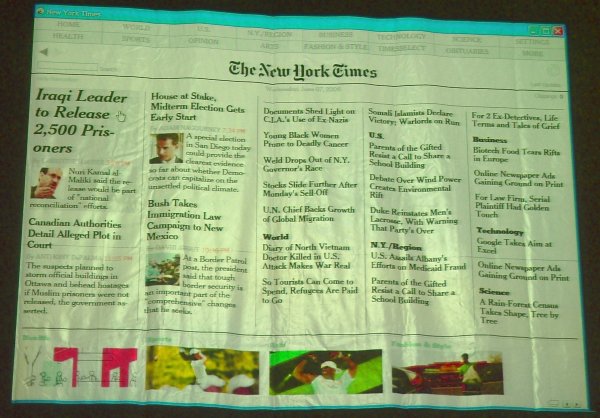
It's been something like six months since the launch of the Times Reader, which I dissed as Microsoft's deja-vision of the future. Now Hearst, which owns the troubled Seattle Post-Intelligencer, has lined up with the dark side, announcing its own downloadable reader. Similar announcements have come from Forbes and London's Daily Mail.
Silicon Valley VC Alan Mutter rightly calls this a case of "trying to jam the square peg of the traditional print product into the round hole of the Internet."
In Clayton Christensen's terminology, this is not only cramming, but overshooting.
Cramming is the act of forcing an old product or business model into a new technological framework, rather than exploiting the new framework for its unique possibilities. Christensen writes: "The problem with cramming is that it changes the innovation in ways that obviate its inherent disruptive energy. It takes an innovation from a circumstance in which its unique features are valuable to a circumstance in which its unique features are a liability.
"Cramming is like trying to stuff a square peg into a round hole. "
As for overshooting, that's the act of "improving" a product in ways that exceed the marketplace's ability to absorb the "improvement." Microsoft is all puffed up about its newfound ability to hand extraordinary typographical control over to the publisher. The problem is that readers are not crying out for better type kerning from an "online newspaper." That's really, really not the problem.
Last week in Moscow at the World Editors Forum I had a chance to hear details of Microsoft's so-called "Times Reader" electronic newspaper vision of the future. A lot of the conversation I've heard about this reader has assumed Microsoft is reinventing PDF. That is not the case.
Instead, Microsoft -- or rather the typography unit within Microsoft -- is trying to reinvent the World Wide Web in ways that are advantageous to publishers (and disadvantageous to consumers).
I have a feeling that I'm peering back into 1994. Control. Look and feel. Offline usability. Client-side page assembly using templates. We had a lot of them in those days in the Interchange platform. Meanwhile, Microsoft was working on its own vision, called MSN, which was going to be a proprietary system on a page-authoring platform called Blackbird.
The primitive HTML Web arrived, with no tools and no layout control and noting but openness to recommend it. And it blew everything away.
In its new proposal, Microsoft provides (sells) the publisher a software development toolkit and presumably access to Microsoft-certified developers who can create a proprietary downloadable application. The application will run only under Windows Vista and versions of XP that have had special add-on libraries installed.
The publisher has to perform a significant amount of work to get a service up and running; it is not a turnkey proposition. The SDK is to be released by the third quarter of this year.
What comes out of the process is a special browser that is hard-wired to the publisher's content. The user must download and install that browser, which places an icon on the desktop.
The project is driven by Bill Hill, a flamboyant Scotsman -- the kind that makes a point of wearing a kilt in public -- who worked for a Scottish newspaper a couple of decades ago. He went into desktop publishing 20 years ago, worked for Aldus, and wound up running Microsoft's typographical operation. He's a passionate lover of type and wants to remake the Web in ways that allow type designers complete presentational control.
Interestingly, Microsoft isn't peddling this idea to the digerati or semidigerati who run the online divisions of media companies. It's approaching the print-centric side directly, presenting at the American Society of Newspaper Editors last month and the World Editors Forum this month.
The Times Reader browser has the following features:
My reaction to all of this is great skepticism. There is not an idea in the entire suite that I have not seen before. It seems to me that Microsoft is solving a series of problems that mean a great deal to Bill Hill and perhaps a few print publishers, but mean almost nothing to the consumer, at a cost to the consumer of additional restrictions, complexity, platform dependence, and lack of interoperability with the Web.
It is the Web, not the desktop, where consumers spent their time. I don't think this train is going to leave the station.
Recent comments
3 days 52 min ago
3 days 18 hours ago
4 days 1 hour ago
4 days 1 hour ago
4 days 1 hour ago
4 days 9 hours ago
4 days 9 hours ago
5 days 19 hours ago
1 week 34 min ago
1 week 19 hours ago