
I don't see any point in joining the snarkfest that is unfolding on some blogs in the wake of the Wall Street Journal's highly critical article about LoudounExtra.com. But it does make me want to pass on some basic points that should be absorbed by anyone thinking about hyperlocal and citizen media.
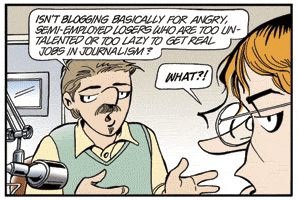
"Hyperlocal" on the Web really has to do with finding natural geocommunities, where interpersonal connections (or great potential for connections) coincide with geography. Natural communities are hard to identify. It's more art than science.
Natural communities may be smaller than you expect. In fact, they may be too small to sustain a media business. That doesn't mean you can't build a business out of a network of hyperlocal products. Don't think monolithic.
Natural communities often don't map to political subdivisions. This is something I learned decades ago in St. Louis, a tangle of overlapping governmental districts that don't supply simple answers the simple question: "Where do you live?"
Natural communities don't necessarily map to the needs of marketers (the people formerly known as "advertisers.") This is increasingly true as America becomes Generica, land of fast-food franchises and big-box retailers. If you're a journalist thinking about doing this, you need to make yourself into a business planner first.
Natural communities have great potential for developing participative Web experiences (the practice formerly and poorly known as "user-generated content.") But it does not happen by accident. If you want to be a convener of community, you'd better be ready to get off your duff, away from the computer, and out in front of people. This is something you have to build by selling it in person to the people you want to engage.
And one last point. Geographic community ties are not as strong in this century as in previous centuries. You can do something about that (see Putnam and BetterTogether.org) but be aware that you're working against a climate shift.
Here's another example of how the Internet has shifted power from institutions, and how that can be a good thing. While the Internet certainly has empowered whispering campaigns and hate bloggers, it also has enabled us to get to the truth behind badly reported news, if we care enough. Today I found the full Jeremiah Wright sermon from Sept. 16, 2001, in which he made the "inflammatory" statement "America's chickens have come home to roost." It turns out he was quoting Edward Peck, former U.S. ambassador to Iraq and deputy director of President Reagan’s terrorism task force. And the focus of the sermon is quite different from what you've heard. Watch it all.
Absolutist declarations of the form "______ is dead" are a cheap way to get links, and universally they are nonsense. Steve Boriss' declaration that "citizen journalism is dead" and "expert journalism is the future" is an example. He incorrectly cites Mark Potts' Backfence and Steve Outing's shutdown of the Enthusiast Group as examples.
Backfence and Enthusiast Group were both commercial failures for unrelated reasons. Backfence simply burned through its cash and ran into a host of internal issues that Potts has hinted at, but not discussed publicly; it was not a failure of the participative model in general. Enthusiast Group's big mistake, in my opinion, was selecting outdoor sports as its topical focus. I learned a long time ago that outdoor people are outdoors, not plopped in front of a computer, and relative to many other affinity groups it's not exactly loaded with commercial opportunity.
What's even more puzzling is lumping Enthusiast Group in with the very concept of "citizen journalism." Makes. No. Sense.
Boriss issues a criticism of citizen journalism that, if true, I would agree with:
"The problem with Citizen Journalism is that it tries to force news back to what it was. Actually, worse than it was. It takes the same stale, one-size-fits-all, center-left, authoritative-tone news model that news consumers are rejecting, then adds large quantities of material from unpaid amateurs who have no particular expertise in reporting, editing, writing, or their topic."
But that doesn't describe what either Backfence or Enthusiast Group was attempting to do, and it certainly isn't adequate to cover the very diverse landscape of emerging participative media, which generally is framed by forums and personal blogs at one end of the shelf, and OhMyNews at the other. That's quite a lot of territory. Applying arbitrary labels and issuing absolute dismissals doesn't advance our understanding.
Thanks to EditorsWeblog.org for the pointer.
Addendum: From the Pew Internet & American Life project comes this commentary, which points out that people often look to both experts and non-experts and make their own evaluations.
All journalism has political implications, and we're seeing that play out in the citizen media space.
Kevin Anderson describes how Google/YouTube has muzzled Egyptian blogger Wael Abbas, who has been posting videos of torture and official violence in Egypt.
Asia Times Online describes the role played by bloggers in Malaysia where it says "independent news websites and blogs have enjoyed a surge in popularity on the back of two huge demonstrations and retaliatory government crackdowns in the heart of Kuala Lumpur, which the mainstream media arguably failed to report accurately or adequately.
(Kevin and I taught last summer at an Ifra citizen media workshop in Kuala Lumpur that was attended by mainstream journalists from Malaysia, Singapore, Thailand and India.)
The diverse, open platform provided by the Internet has perforated the ability of autocrats and bureaucrats to control information. But messages need audiences. Centralized systems like YouTube can provide those audiences, but at a cost of creating a centralized point of control that may be manipulated by governmental pressure.
Both Google and Yahoo have shown repeatedly that when the chips are down, their commercial interests will trump social responsibilities.
In my book Andrew Keen is a pompous fraud
and I wouldn't cross the street to put him out if he were on fire, so I particularly enjoyed seeing Markos Moulitsas expose Keen's sloppy "professionalism."
Moulitsas (aka Kos) quotes Keen's book...
It is not surprising then that these prominent bloggers have no professional training in the collection of news. After all, who needs a degree in journalism to post a hyperlink on a Web site? Markos Moulitsas Zuniga, for example, the founder of Daily Kos, a left-leaning site, came to political blogging via the technology industry and the military.
... and then points out that he (Kos) has a degree in journalism (as well as several others), served as editor of his college newspaper, freelanced several years for the Chicago Tribune and has written for the Guardian. (Thanks to Martin Stabe.)
Keen is not a journalist but rather a professional self-promoter. Nevertheless, his straw-man dismissal of blogging is a position still held by too many in journalism.
Across the pond in the UK, there's a bit of a revolt against the National Union of Journalists over luddite positions being taken by the union. Suw and Kevin take a swing, and Neil McIntosh offers some suggestions as to how the NUJ could make itself useful.
An editor for Ifra's magazine, Newspaper Techniques, interviewed me via email. Here's my response:
How can newspapers implement community sites?
I think the first step is to recognize the nature of community, and the constructive role played by journalism.
We typically don't do that. We typically think our job begins and ends with "covering the news," and we don't think carefully enough about what effects we have in the community.
Our goal should be helping build a society in which people are not only well informed, but are empowered and motivated to participate actively. Every decision we make, every coverage choice, affects that goal.
The word "community" is a slippery one, and the definition is changing. We used to think of a community as a place. The Internet has created a new definition: communities of interest.
There's a lot we can learn from Internet startups if we just recognize that geographic community is actually a special interest. A smart special-interest community-builder works to heighten participants' sense of identity -- of being part of something special. Traditional, local media can do that, too.
How can a newspaper group start something similar to BlufftonToday.com? What is needed in terms of technology? How can such a 'newsroom' be organised?
The important thing to recognize about Bluffton Today is that it's a multimedia operation that endeavors to exploit the unique strengths of each medium.
The newspaper is free and home-delivered, taking advantage of print's advantages in browsability and discovery.
The website engages people in a conversation through blogs and photo-sharing, taking advantage of the Internet's advantages in human interaction and immediacy.
These two sides come together through a professional news staff that uses the Web as a listening post. We pick up some blogs and photos for the print product, but the real "secret sauce" is that the community conversation helps the professional journalist connect with the real interests and passions of regular people, and not just the agendas of the institutions and newsmakers that pro journalists usually cover.
Our own research shows that the professional news staff of Bluffton Today is closely aligned with members of the community when asked about community issues and problems, while there is a big gap at most other newspapers. We think that tight alignment is one of the big factors contributing to the extraordinary readership success of the newspaper.
To make this work, the news staff has to be broadly engaged with the website and the blogging process. It's more a matter of culture change and mindset than organizational structure, although the wrong structural approach can certainly build barriers and walls between journalists and the Web. We're moving toward very deep integration of the Web into the newsrooms of all of our newspapers.
The technology isn't difficult or expensive, and the open-source software movement is making that more true every day. We wrote our own photo-sharing software to meet our specific needs, but our blogging and social networking tools are built on the free Drupal platform. Since we launched BlufftonToday.com on April 1, 2005, hundreds of newspapers around the world have adopted Drupal as an online community technology.
Open source works best when "many hands make light work." Ken Rickard at Morris DigitalWorks has contributed a very powerful personalization module to Drupal, and I would strongly encourage other newspaper companies to make similar technology contributions. You can learn more at http://groups.drupal.org/newspapers-on-drupal.
What would be the job description for a citizen journalist?
I would rather look for an effective citizen than a "citizen journalist."
We're not looking to have citizens do our jobs for us, although there will often be a big overlap in roles played by an active citizen and a professional journalist.
In general, people are not looking to become amateur news reporters. They're primarily looking to join in Internet conversations that meet a number of very personal needs, and those conversations can touch on topics from the mundane to the profound.
The important thing for us to recognize is that all of those conversations -- including the mundane -- are valuable and help people build the relationships that enable meaningful community interaction to take place. Small talk is important.
This process of building "social capital" lays the foundation for a community, whether it's a community of geography or of interest.
We all tend to cite the example of the 2005 London bombings as an example of how anyone can be a journalist in a crisis.
I think the more interesting thing is how anyone can be an investigator every day.
The Web is enabling activists to organize and self-publish. We're seeing activists take on the role of watchdog, and we're seeing activists digging through public information and looking for patterns, and we're seeing activists reveal truths that others would prefer to keep hidden. We should embrace that change. We should celebrate and call attention to their successes, and we should correct their failures.
What is the best way to manage an on-line newspaper with user generated content?
We need to become convenors, guides, facilitators and participants.
Here are a few skills that deserve special attention:
Community building: We should be picking the brains of sociologists, psychologists and political scientists for everything they can tell us about how we can get people away from their TV sets and into group processes with their neighbors.
Conversational writing and listening: A lot of journalists are dreadfully inept when handed a weblog. A successful blogger knows how to select topics that people care about, how to write informally and conversationally, how to be brief, how to listen to responses, and how to interact.
Presentations and group interaction: We can't be successful conveners of communities if all we do is sit on our backsides and play with computers. We have to get out of the office and in front of individuals and groups, talking and listening and selling the idea of joining in an online process that will make the local community a better place.
Guerrilla marketing and promotion: Journalists like to pretend that some magic fairy will swoop down and take care of marketing and promotion, but it doesn't work that way. Getting people to read and participate is everyone's job. One of our most successful efforts is Spotted, our photo-sharing program, in which we send staffers, interns or volunteers out to shoot hundreds of photos of people who are attending public events (turning the camera around on the audience). Each photo subject gets a "You've Been Spotted" business card with the website's address. It works.
Humility: The managing editor of Bluffton Today spent one afternoon soaked in soapy water, bathing dogs to raise money for the local humane society. We all need to climb down from our self-constructed pedestals and get comfortable with the crowd. Arrogance is the cancer of professional journalism, and we need to stop it.
Ifra's Citizen Media Summit in Malaysia looked like it might not happen, but the word this morning was that the class enrollment was sufficient, so we're greenlighted. If you're interested in attending, there's probably still space available. The three-day, workshop-style conference will be held July 2-4 at the Parkroyal Kuala Lumpur Hotel.
Recent comments
3 hours 43 min ago
4 hours 7 min ago
3 days 7 hours ago
6 days 18 hours ago
1 week 1 day ago
2 weeks 2 days ago
2 weeks 3 days ago
2 weeks 3 days ago
3 weeks 5 days ago
3 weeks 6 days ago